Online Course Essentials | Orientation
Course offers a variety of methods for assessment; assignments support learning aims and include clear instructions; criteria for assessment is clearly articulated (rubrics, detailed feedback).
Ensure that your assignment requirements are clear to students. Explain how your assignment is designed to measure their ability to analyze complex and nuanced topics, solve problems, and make deeper connections.
Learn More
Learn More
Assessments
Elements
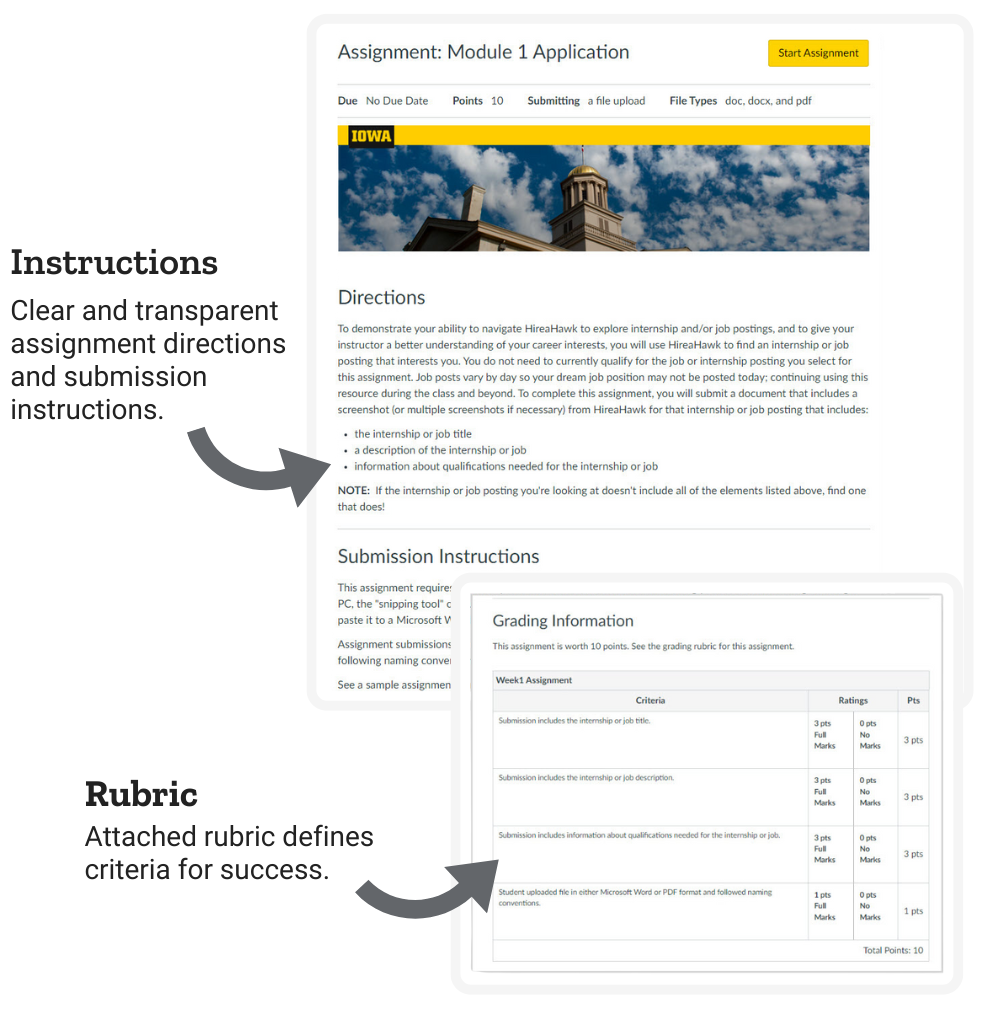
Instructions
Ensure students have all the information they need included directly on your ICON assignment screen. Do students understand the purpose of your assignment (i.e.: building their working knowledge, advancing industry-specific skills)? Do they know which steps they should take to complete the assignment, and the criteria for how you will grade their work?
Rubric
Rubrics are an effective way to communicate expectations and grading criteria with your students. The ICON Rubric tool helps you format your rubric criteria for students and speeds up grading.
Research
Key purposes of assessment are: to demonstrate learning achievements (i.e.: assessment of learning), to get and give feedback (i.e.: assessment for learning), and to self-regulate learning including critically evaluating one’s own performance (i.e.: assessment as learning) (National Forum, 2017).
Transparent assignment design includes connection to learning objectives (skills and knowledge), a list of tasks students should take, and criteria for success that defines elements of successfully completed student work (Winkelmes, 2013).
Feedback is concrete, specific, and useful; it provides actionable information and suited to the learner’s level of comprehension. In most cases, the sooner I the learner gets feedback, the better. The learner should have opportunities to use feedback on subsequent activities. (Wiggins, 2012).
Related Reading
Related Reading
Transparent Teaching
The University Iowa Center for Teaching shares evidence-based strategies for increasing student achievement, including articulating purpose of academic work, clarifying steps students should take to complete assignments, and communicating the criteria for their success.
Rubrics
The importance of rubrics in online learning is clear: they clarify your expectations and provide transparency for assignments such as reflection papers, asynchronous discussions, and group projects.
Authentic Assessment
Engage students in real-world tasks that demonstrate their knowledge and skills, requiring them to apply what they've learned to meaningful, discipline-relevant scenarios.